

Operational Trust: Why Zero Trust Must Extend Beyond the Network and into the PLC
Cybersecurity Has Protected Data. The Next Challenge Is Protecting Reality.
Data Has Been Protected by Cybersecurity. The Next Challenge Is Protecting Reality.
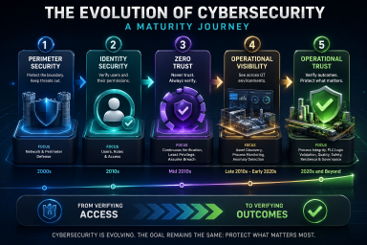
Cybersecurity Has Protected Data – Now It Must Protect Outcomes.
Cybersecurity has evolved from perimeter firewalls to identity-driven Zero Trust architecture over the past 20-plus years. Organizations have made substantial investments in protecting not only users, devices, cloud workloads, applications, and networks, but also providing far better enterprise security.
But manufacturers, utilities, pharmaceutical companies, and critical infrastructure operators still face cyber incidents that disrupt operations and not only expose information. The thread they all share is that virtually all security programs end where the physical world begins. Zero Trust verifies who accessed a system; Operational Trust verifies what the system did. The Last Blind Spot in Zero Trust revolutionized the way we think of identity, least privilege, and never-ending verification.
This does not change, however, with industrial environments that are dependent on programmable logic controllers (PLCs), sensors, actuators, and engineering workstations to communicate digital commands or generate operational outcomes. Legitimate credentials and normal network traffic may not assure that controller logic is trustworthy or that a production process is running in a safe manner. Ultimately, executives require confidence not just in access decisions but also in operational outcomes.
Zero Trust, Complemented by Operational Trust, Operational Trust is not a substitute for Zero Trust…it is the logical development of the same. While Zero Trust is a philosophy that validates a constant set of information from users, devices, and communications, Operational Trust takes that principle further and validates industrial control systems by verifying the authenticity of controllers, changes made to their design, sensor values, and physical process outputs. It transforms cybersecurity from protecting digital only to performing regular verification of the security of the operational environment.
Why Does PLC Visibility Change Everything?
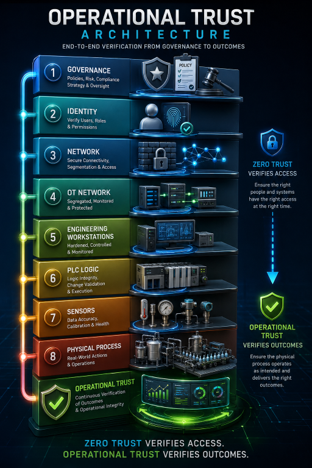
Operational technology has some of its most notable development where it could be observing and validating on the inside of PLCs, rather than analysis being limited to data from network traffic. Traditional OT watching is still needed, but packet checking is not always sufficient to detect whether controller logic is different or a process is creeping out of the acceptable range. “Deep PLC visibility adds operational context, allowing organizations to differentiate between authorized maintenance, equipment malfunctioning, and potential cyber attack.”
Beyond Cybersecurity: Operational Excellence
Operational Trust provides benefits that go beyond security. Real-time validation of controller logic, engineering upgrades, and process behavior further increases the quality assurance, preventive maintenance, root cause testing, and ongoing improvement efforts.
Instead of identifying deviations after production has finished, the organizations are able to have issues detected much sooner, which decreases the downtime and waste as well as risks to systems, resulting in higher confidence in the quality of the output at the production level.
Food Manufacturing Is One Example
Food production is the perfect example, as even a small adjustment in temperature, timing, or batching, or with valve sequencing, can result in spoilage of products, recalls, or even regulatory concerns. But the same goes for pharmaceuticals, water treatment, energy, transportation, every single one of our industrial settings that has cyber systems affecting physical outcomes. This is not confined to a particular industry; Operational Trust is a governance for contemporary operational technology.
Executive Perspective
As a Board Advisor for CSAFI.org, I think cybersecurity increasingly needs to be seen in terms of operational integrity. Currently, I am not aware of any existing technologies other than OTegrity (www.otegrity.io) that can continuously assure operational activity through the PLC layer. This technology is a big step forward because they help organizations respond to a question traditional cybersecurity struggles to answer:
Can we have faith in the process itself?
These features support the Zero Trust model but also enhance quality control, operational resilience, and executive empowerment.
Final Thoughts
A more nuanced view of the next ten years of cybersecurity isn’t just about a beefed-up digital defensive posture, but an organization’s aptitude to constantly validate systems producing real-world results.
Operational Trust takes the principles of Zero Trust a step further; it uses information to help organizations gain better confidence in resilience, decrease downtime, improve quality, and gain trust in operational integrity.
The next generation of industrial cybersecurity will be with those who can validate digital access and physical results alike.
About the Author
Scott Alldridge is President & CEO of IP Services, President of the IT Process Institute, and a Board Advisor for CSAFI.org. He holds an M.B.A. in Cybersecurity, is a Certified Chief Information Security Officer (CCISO), and is Harvard Certified in Technology and Privacy. A two-time bestselling author with more than 350,000 books sold in the VisibleOps series, Scott is a recognized authority on cybersecurity, AI governance, Zero Trust, and operational resilience with more than 30 years of industry leadership.