

Continuous Penetration Testing: From Annual Snapshots to Verified Risk Reduction
By Scott Alldridge MBA / CCISO / CISSP | President & CEO, IP Services | Author, VisibleOps Series | October 2026
The best security programs do not just find vulnerabilities. They prove that the most dangerous ones are fixed.
For decades, the annual penetration test has served as a familiar milestone. A firm tests a defined set of systems, delivers a report, and the organization works through the findings. Twelve months later, the exercise repeats. That approach still provides useful independent assurance, but it was designed for a world in which infrastructure changed more slowly.
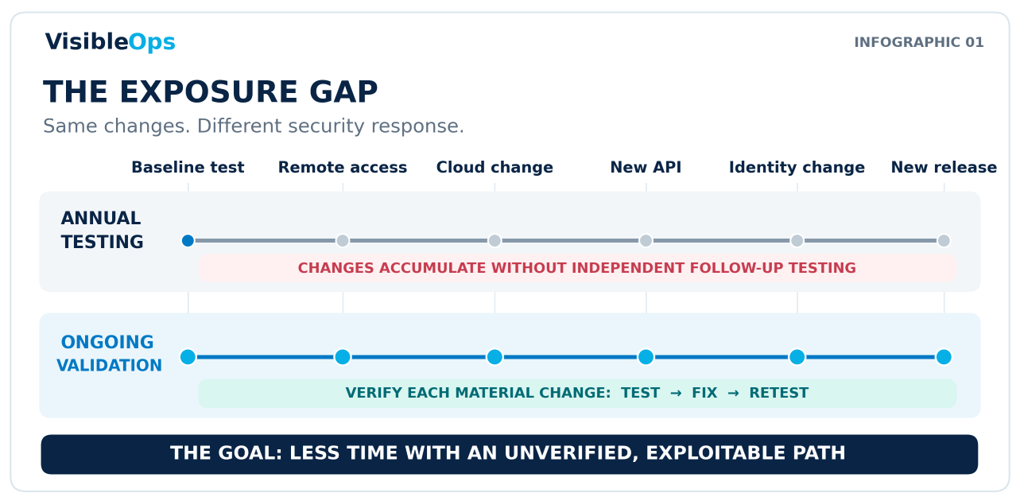
INFOGRAPHIC 1 | Annual-only testing leaves more time between changes and independent validation.
Today, companies release applications continuously, add cloud services in hours, connect new partners through APIs, and change identity permissions every day. A clean report in January tells leadership little about a cloud configuration introduced in March or a vulnerable customer portal deployed in August. Attackers do not wait for the next assessment cycle.
My VisibleOps perspective is straightforward: cybersecurity is an operating discipline, not an annual event. Discover the risk, assign ownership, control the change, and verify the result. Continuous penetration testing becomes valuable when it shortens that entire cycle -not merely when it produces more findings.
The real weakness in once-a-year testing
Annual testing gives a point-in-time view of a changing environment. Consider a manufacturer that passes an external assessment, then deploys a remote-access gateway, modifies firewall policies, launches a supplier portal, and connects an acquired business. Each change may be justified. Together, they alter the attack surface that was originally tested.
Without change-triggered validation, a serious weakness can sit between test dates for months. Meanwhile, vulnerability scanners produce their own lists, operational teams struggle with competing priorities, and the final pentest report may arrive weeks after a weakness was discovered. The weakest link is often not the test. It is the handoff from discovery to a verified fix.
The practical shift is from calendar-based assurance to risk-based, event-driven validation. Keep the formal annual assessment where contracts or standards require it, but add ongoing discovery, focused testing of material changes, and rapid retesting after remediation.
Know the difference: scanning, penetration testing, and validation
These terms are frequently used interchangeably, but they perform different jobs. Vulnerability scanning checks assets against known flaws, missing patches, insecure configurations, and exposed services. It is broad, repeatable, and increasingly automated. Every organization should be doing it regularly across its relevant environment.
Penetration testing goes further. Skilled, authorized testers try to establish whether a weakness can actually be exploited and whether multiple seemingly modest weaknesses create a path to a valuable system. A scanner might flag an exposed management port. A tester may establish whether that port, combined with a weak identity configuration, could give an attacker privileged access. The business consequence changes the urgency.
Continuous validation ties the two together with attack-surface discovery, targeted human-led testing, threat intelligence, ticketing, remediation, and retesting. Automation delivers speed and coverage; people deliver context, creativity, and evidence of real-world impact. The OWASP Web Security Testing Guide and CIS Control 18 reinforce the need for a defined testing program, skilled assessment, remediation, and validation of security measures. [3, 4]
A tool that runs an automated scan every day is not automatically providing continuous penetration testing. Ask what has been manually validated, which attack paths were actually demonstrated, and how closure was independently confirmed.
What the latest research tells executives
The 2026 Verizon Data Breach Investigations Report found vulnerability exploitation was the leading known initial-access vector, appearing in roughly 31% of breaches in its reporting dataset. It also reported that the median time to fully remediate known-exploited vulnerabilities rose to 43 days. That figure applies to the report’s tracked exploited-vulnerability data; it is not a universal patching average. [1]
The 2026 State of Pentesting study by Cyentia Institute and Cobalt reviewed more than 16,500 tests across nearly 3,000 organizations. The top-performing tenth of organizations reduced half their high-risk findings within about 10 days. The slowest tenth needed 249 days. Teams operating programmatic testing were 4.5 times more likely to resolve critical findings within three days than ad hoc or compliance-driven teams. [2]
Those numbers do not prove that buying any particular PTaaS product cuts everyone’s remediation time in half. They show that the operating model matters. A defensible goal is to measure your own starting point and reduce it-for example, moving a 60-day verified-remediation cycle toward 30 days-without sacrificing safety or evidence quality.
The VisibleOps continuous verification loop
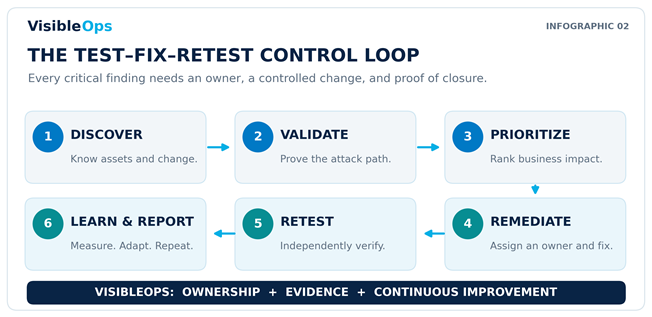
INFOGRAPHIC 2 | Continuous validation only reduces risk when findings lead to owned, verified fixes.
At IP Services, we think of risk reduction through the lens of people, process, and technology. A finding should travel through a controlled workflow rather than live indefinitely in a spreadsheet. Six connected activities make that possible.
Discover. Keep an accurate inventory of Internet-facing assets, cloud accounts, APIs, remote-access services, and important identity paths. Include newly acquired systems and shadow IT. Unknown assets cannot be reliably tested.
Validate. Combine automated discovery with authorized, human-led testing to determine whether suspected weaknesses create a credible attack path. Capture enough evidence to reproduce the result without unnecessarily exposing data.
Prioritize. Give greater weight to active exploitation, Internet reachability, privileged access, sensitive information, and business interruption. A theoretical medium-severity issue on a critical identity system may deserve faster action than a high-severity issue with no realistic exposure.
Remediate. Put the finding in the normal IT service-management and change-control workflow. Assign one accountable owner, a target date, an approved change, and an escalation route.
Retest. Have the testing team confirm the attack path is closed. A completed ticket is a process state; a successful retest is evidence. If the fix fails, reopen the issue and preserve the audit trail.
Learn. Identify repeated root causes. If the same insecure configuration appears every quarter, change the build standard, release checklist, or privileged-access policy. Continuous improvement should eliminate classes of weaknesses, not just individual tickets.
Prioritize exploitable paths, not the longest list
One reason remediation stalls is that teams are flooded with undifferentiated findings. The best programs apply business context before asking engineers to act. Start with CISA’s Known Exploited Vulnerabilities catalog for evidence that a CVE has been exploited in the wild. Add FIRST’s Exploit Prediction Scoring System (EPSS) as one signal of the likelihood of exploitation over the coming 30 days. EPSS is a probability estimate, not a complete business-risk score. [5][6]
Then evaluate what matters inside your organization: Is the system Internet-facing? Does it control identity or remote access? Could compromise expose regulated data, interrupt patient care, stop production, or enable lateral movement? Is a compensating control actually working? Has the SOC seen relevant attacker behavior?
This is where Zero Trust earns its value. Penetration testing can challenge assumptions about least privilege, multifactor authentication, segmentation, access between workloads, and the ability of a compromised account to move deeper into the environment. A firewall rule or security product should not be considered effective simply because it was purchased and configured.
The output should be a small number of validated attack paths with named business owners, supported by a broader queue of lower-priority hygiene issues. That is much more useful than measuring success by the number of vulnerabilities discovered.
Make remediation an operational workflow
Discovery only reduces risk when it leads to action. Every critical or high-risk finding needs a single tracking record, linked affected assets, an accountable owner, a realistic due date, and a documented validation standard. The security team supplies exploit evidence; infrastructure or application teams own approved changes; the tester independently confirms the result.
For example, a penetration tester finds an exposed administrative service. The SOC and IT team immediately establish whether there is evidence of compromise, restrict exposure if appropriate, and open a change request. The change is reviewed under an emergency path when warranted. A tester then checks that external access is blocked and that alternate routes do not remain. The record includes discovery time, containment time, remediation time, retest time, and any accepted residual risk.
This is where traditional ITIL-aligned practices become a cybersecurity advantage. Configuration management identifies the affected asset. Change management protects production stability. Incident response addresses suspected exploitation. The risk register documents exceptions. Executive reporting shows whether controls are improving. None of these activities is glamorous, but together they make remediation repeatable.
Testing also needs rules of engagement: written authorization, defined scope, acceptable techniques, maintenance windows, data-handling requirements, escalation contacts, and stop conditions. Continuous does not mean uncontrolled. Healthcare, financial services, industrial control systems, and operational technology require particularly careful scoping to avoid unsafe or disruptive testing.
Tests on what changes-including AI and identity
A mature program does not treat every system equally. Use continuous scanning and external-asset monitoring for broad coverage, then schedule skilled testing when meaningful changes occur: a new public application or API; a major cloud migration; an identity-provider or conditional-access redesign; a merger; a new third-party integration; or a production release affecting authentication and authorization.
Identity deserves special attention. Attackers increasingly target service accounts, tokens, session controls, exposed secrets, privileged roles, and machine-to-machine connections. Tests should answer whether stolen credentials or a compromised workload could bypass segmentation and reach valuable data.
AI applications introduce additional paths: prompt injection, insecure tool permissions, sensitive-data leakage, untrusted retrieval content, and overly autonomous agents. The 2026 State of Pentesting report found a higher share of high-risk findings in AI/LLM assessments than in its broader test dataset. That is a reason to test AI-specific trust boundaries-not to assume a traditional web-app scan covers them. [2]
Measure closure, not activity
Boards and executive teams need a handful of measures that connect cybersecurity activity to risk reduction. High-risk finding half-life measures how long it takes to close half of those findings, including the influence of issues left open. Verified remediation time measures elapsed time from confirmed discovery to successful retest, not merely ticket closure. SLA attainment shows the share resolved within the agreed risk-based deadline.
Add retest pass rate, repeat-finding rate, and exposure age for Internet-facing critical issues. Report exceptions and accepted risks openly. Track changes in these measures quarterly and separate genuine fixes from compensating controls or risk acceptance. A dashboard should tell executives whether the risk window is shrinking, not simply whether the team ran another test.
This matters because perceptions can be misleading: the Cobalt study found a substantial gap between executive confidence in remediation SLAs and practitioners’ assessment of actual performance. Reliable, shared evidence helps close that governance gap. [2]
A realistic 90-day starting plan
Days 1–30: establish the baseline. Inventory critical external assets and applications. Review the most recent pentest, vulnerability backlog, threat intelligence, open exceptions, and change calendar. Agree on testing authorization and identify who can approve urgent remediation. Calculate the current median verified-remediation time and the age of open high-risk findings.
Days 31–60: operationalize the handoffs. Launch continuous asset discovery and scheduled scanning. Select a skilled testing partner for focused validation of high-risk systems. Route validated findings directly into the service desk with a named owner and risk-based deadline. Establish fast escalation for exploitable external exposures and a clear retest request process.
Days 61–90: prove improvement. Test a recent application, identity, or infrastructure change. Verify fixes against the original attack path. Review recurring causes and update baseline configuration or access-control standards. Publish an executive scorecard showing discovery-to-validation time, verified-remediation time, overdue critical findings, and retest results. Adjust testing frequency based on risk and actual operational capacity.
For a smaller business, this may mean continuous perimeter monitoring, periodic targeted human testing, and rapid retesting, rather than a full-time offensive team. For a complex enterprise, it may mean parallel application, cloud, identity, and internal testing workstreams. The principle is the same: make testing proportional to exposure and make fixing a managed process.
Compliance is the floor, not the finish line
Standards remain important. CIS Control 18 calls for a documented testing program, periodic internal and external tests, remediation, and validation. NIST SP 800-53 addresses continuous monitoring through CA-7 and penetration testing through CA-8; neither mandates daily human-led tests. [4, 7]
Whether your organization manages SOC 2, HIPAA, NIST 800-171/CMMC, PCI requirements, or customer contractual obligations, confirm the specific testing expectations that actually apply. Continuous validation can strengthen your evidence and readiness, but it does not automatically replace a required independent assessment or guarantee compliance. The outcome auditors and business partners ultimately want is an organization that can demonstrate it identifies and manages risk between formal reviews.
The question every leader should ask
Do not begin by asking a vendor, “How many scans do you run?” Ask who performs real exploitation testing, what triggers a new assessment, how findings enter your change process, whether retesting is included, and how quickly you can see evidence of closure. Those questions expose the difference between a testing subscription and a working risk-reduction program.
The annual penetration test still has a place. What should disappear is the idea that last year’s report proves today’s defenses. Continuous penetration testing is most effective when it becomes part of a larger VisibleOps discipline: make the exposure visible, put someone in charge of the fix, and independently prove the control works.
The best measure of cybersecurity maturity is not how many findings you generate. It is how little time your organization leaves a known, exploitable path open.
Trust your controls. Continuously verify them.
Research and further reading
[1] Verizon | 2026 Data Breach Investigations Report (DBIR)
[2] Cyentia Institute and Cobalt Security | 2026 State of Pentesting Report
[3] OWASP Foundation | Web Security Testing Guide
[4] Center for Internet Security | CIS Controls v8.1 – Control 18: Penetration Testing
[5] CISA | Known Exploited Vulnerabilities catalog
[6] FIRST | Exploit Prediction Scoring System (EPSS) – FAQ
[7] FedRAMP / NIST | CA-7 Continuous Monitoring and CA-8 Penetration Testing control guidance
[8] Synack | How Does Continuous Penetration Testing Work? (2026)
[9] Penough | Continuous Pentesting: How to Cut Your Remediation Time in Half (reference article)
© 2026 Scott Alldridge / IP Services. All rights reserved.